| Search for content and authors |
Effects of Gd substitution on the metamagnetic transition of NdCo9.5V2.5 |
| Xiao Hai 1, Weifang Liu 1, Ping Wu 1, Guangyao Liu 2, Guanghui Rao 3 |
|
1. Department of Physics, School of Science, Tianjin University, Tianjin 300072, China |
| Abstract |
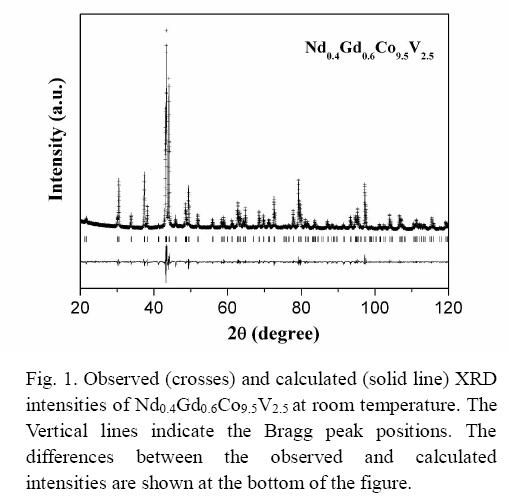
Crystal structure and magnetic properties of the Nd1-xGdxCo9.5V2.5 compounds (x = 0-1) have been investigated. The compounds crystallize in the tetragonal ThMn12 structure with space group I4/mmm. The lattice parameters a, c and the unit cell volume V decrease with the increase of Gd content. The Curie temperature of Nd1-xGdxCo9.5V2.5 increases monotonically upon the substitution of Gd for Nd. The critical field HcritL required to induce the magnetization jump decreases with increasing Gd content. The metamagnetic transition phenomenon becomes less obvious and even disappears with the substitution of Gd for Nd. The HcritH required for the metamagnetic transition increased with increasing Gd content at low substitution content. The saturation moment MS of the compounds decreases first then increases with the increased Gd content. 1. Introduction Ternary rare-earth compounds with the tetragonal ThMn12 structure belong to the family derived from the RT5 (CaCu5-type structure, space group P6/mmm) and form an important class of materials that find numerous industrial applications in permanent magnets and magneto-optical recording, as well as in the aerospace domain [1, 2]. Among these intermetallic compounds, the R(Fe, M)12 compounds have attracted considerable attention owning to their relatively high Curie temperature and saturation magnetization as well as large uniaxial magnetocrystalline anisotropy at room temperature. In order to understand the magnetism of the R(Fe, M)12 compounds and improve their magnetic properties, a series of experiments concerning the substitution of Fe by Co have been undertaken [3, 4]. Jurczyk and Christyakov [5] showed that it is possible to prepare also Co rich compounds of the same structure. In general, the contribution of rare-earth metal to magnetic anisotropy energy has opposite signs in RFe12-xMx and RCo12-xMx [6]. Recently, we conducted a series of investigations on the ternary rare-earth compounds R(Fe, Co and V)12 (R=Y, Nd) [7-10]. Some essential phenomena were observed: (i) A metamagnetization transition phenomenon occurred when a high field up to 140 KOe was applied, accompanied by an increase of the magnetization of about 3.1μB per formula for NdCo9.5V2.5 [7]; (ii) Fe substitution for Co in NdCo9.5V2.5 could result in a shift of the critical field required for the metamagnetic transition, which may be understood by considering the combined effects of the exchange coupling parameter JRT (between R and T atoms) and the T-sublattice moment μT [9]; (iii) Nonmagnetic element Y substitution for Nd in NdCo9.5V2.5 decreases the critical field due to the weakening of the anisotropy field of R-sublattice. As a continuation of the systematic study on the metamagnetic transition of the compound NdCo9.5V2.5, in this paper we report the structure and magnetic properties of Nd1-xGdxCo9.5V2.5. Since Gd is a magnetic element and the 4f shell is half filled so that its second Steven factor αJ = 0, the substitution of Gd for Nd provides an opportunity for obtaining a deeper understanding of the magnetic properties of the compounds. 2. Experimental details Samples of polycrystalline Nd1-xGdxCo9.5V2.5 (x=0, 0.1, 0.3, 0.6, 0.8, 0.9, 1) were prepared by arc melting the appropriate amounts of the constituent elements Nd, Gd, Co, and V with purity better than 99.9% under a high purity argon atmosphere. Appropriate excess amounts of Nd and Gd were added to compensate for the weight loss during arc melting and subsequent heat treatment. After arc melting, the polycrystalline specimens (ingots) were wrapped in Ta foil, sealed into evacuated quartz tube and annealed at 1373K for 1 week. To avoid possible phase transition during cooling, the samples were quenched into water. The crystal structure was determined by X-ray powder diffraction (XRD) technique. The XRD experiments were performed on a Rigaku D/max 2500 diffractometer with Cu Kα radiation in the 2θ range (20-120o). A step-scan mode was adopted with a sampling time of 1-2 s and a step width of 2θ =0.02o. The data were further analyzed via the Rietveld refinement technique by using the program Fullprof [11]. The temperature dependence of the ac susceptibility of the samples was measured by a mutual inductance method with a fixed frequency of 240 Hz. Curves of magnetization versus temperature (M-T) for the samples were measured by a SQUID magnetometer in a field of 500 Oe. The field dependence of the magnetization (M-H) at 5K of the fine powder was measured using a PPMS. 3. Results and discussion 3.1 Crystallography The structure of Nd1-xGdxCo9.5V2.5 (x = 0, 0.1, 0.3, 0.6, 0.8, 0.9, 1) was examined by X-ray diffraction and thermo-magnetic analysis. All the samples exhibit single-phase tetragonal ThMn12 structure. The observed, calculated, and difference XRD patterns resulting from the Rietveld refinement [12, 13] of Nd0.4Gd0.6Co9.5V2.5 is shown in Fig. 1. The unit-cell parameters a, c and unit-cell volume V of the compounds are shown in Fig. 2 and listed in Table 1. Gd substitution in the Nd site leads to a decrease in the unit-cell volume from 333.1 Å3 for NdCo9.5V2.5 to 329.8 Å3 for GdCo9.5V2.5. The decrease in unit-cell volume with increasing Gd content consists with the fact that the atomic radius of Gd is smaller than that of Nd. The values of a, c and V for x = 0, 1 agree well with those reported in [10, 14]
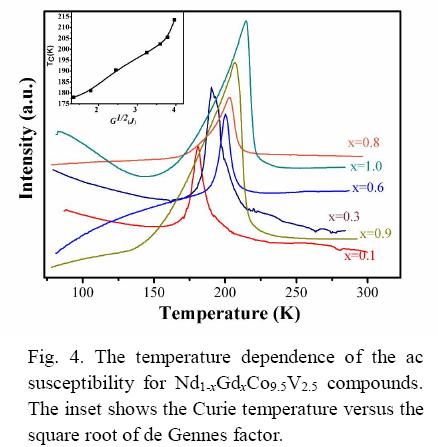
3.2 The Curie temperature and exchange interaction Temperature dependence of the magnetization measured in an applied field of 0.5 KOe is shown in Fig. 3. The Curie temperature TC was derived at the temperature where dM/dT shows minimum on the high temperature region. The dependence of Curie temperature on the Gd concentration is shown in inset of Fig. 3 and listed in Table 1. Fig. 4 shows the temperature dependence of the ac susceptibility χ ac of Nd1-xGdxCo9.5V2.5. The exhibits a distinct susceptibility peak near the Curie temperature. According to Landau theory, the critical peak of χ ac can be deliberated on the basis of the expression for the susceptibility
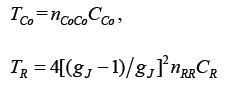
In rare-earth compounds, three types of exchange interactions exist: R-R, R-T and T-T, and the R-R interaction is so weak that it usually can be neglected. The exchange interactions in the rare-earth intermetallics can be derived from the expression for the magnetic ordering temperature under the molecular field approximation [16]: WhereTCo,TR and TRCo represent the contributions to TC owning to the Co-Co, R-R, and Co-R exchange interactions, respectively, and are given by and where Where NCo and NR are the numbers of Co and R atoms per unit volume, and nCoCo, nRR and nRCo are the molecular-field coefficients. Since the R-R interaction is very weak, nRR may usually be neglected. It is obvious that the TRCo is proportional to nRCoand 3.3 The domain wall pinning effect and metamagnetic transition At low temperature, a steep increase of the magnetization occurs as shown in Fig. 3. This typical behavior is characteristic of ferromagnetism when narrow domain walls are present, as found previously in other anisotropic rare-earth compounds. Fig. 5 (a)-(f) show the field dependence of the magnetization of Nd1-xGdxCo9.5V2.5 at 5 K from 0 to 140 kOe, which exhibits a field induced magnetic jump for all of the compounds below 10 kOe, as we observed previously. This behavior can be due to the narrow domain wall pinning effect. As shown in table 1, the critical field HcritL required to induce the magnetic jump decreases with increasing Gd content. HcritL is determined from the peak position in the differential of the magnetization with respected to the field (dM/dH-H). It is well known that the domain-wall pinning can result from a competing between the magnetocrystalline anisotropy of the compound and the exchange energy. With substitution of Gd for Nd, the required HcritL decreases monotonically due to the weakened rare-earth sublattice magnetocrystalline anisotropy. According to the law of approach to saturation, the saturation moment MS of the compounds can be derived by extrapolating the high-field part of the M-1/H curve to 1/H=0. The derived MS decreases for x = 0-0.8 and increases for x = 0.8-1.0 as shown in Table 1, which induced by the antiparallel of Gd moments and Co moments. With the substitution of Gd for Nd, the magnetization direction changed for x=0.8. In our recent investigation on NdCo12-xVx compounds, it is observed that when the applied field is higher than 15 kOe, the magnetization exhibits a plateaulike feature up to 60 kOe. When the applied magnetic field was up to 140 kOe, it was observed that a metamagnetic transition occurred at a critical field of about 60 kOe, as shown in Fig. 5(a). Substitution of Y for Nd in NdCo9.5V2.5 decreases the critical field HcritH required for the metamagnetic transition, and the metamagnetic transition becomes broad and eventually disappears with the increase of temperature, as shown in the inset of Fig. 5(g). Here, the magnetization curves were measured up to 140 kOe, it can be seen from Fig. 5(a)-(f) that at lower Gd substitution (x =0, 0.1, 0.3), the plateaulike feature remains, however, with increasing Gd content (x = 0.6, 0.8, 0.9, 1), the metamagnetic transition becomes broadened and disappears.
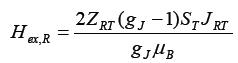
Rao et al [8] revealed that when an external field applied perpendicular to the c axis, the Nd moments prefer to stay along the c axis while the Co moments will tend to realign in the a-b plane, leading to a tilting off the c axis of the magnetization vector corresponding to one of the two minima of the total energy. As the applied field increases, the energy gain from the Zeeman interaction will overcome the easy-c anisotropy of the Nd sublattice and the Nd moments will be pulled into the a-b plane, leading to the occurrence of the metamagnetic transition from the low magnetization state to the high magnetization state and producing a two-step behavior on the magnetization curve. For Nd1-xGdxCo9.5V2.5 compounds at lower Gd substitution, the critical field HcritH increases with increasing Gd content (HcritH is 62.5, 71.0, and 86.5 KOe corresponding to x = 0, 0.1, and 0.3, respectively). For the rare-earth sublattice, the effective field acting on it can be described as where ZRT is the coordination number of T around R. JRT is the exchange-coupling parameter between R and T. Thus, the Hex,R is closely associated with the exchange-coupling parameter JRT and the T sublattice spins ST. The substitution of Gd for Nd on one hand decreases the lattice parameters and leads to an enhanced JTT and JRT and increases the T- sublattice moment μT , on the other hand can also decrease the JRT as mentioned by Liu et al [17] that an even stronger decrease of the radius of the 4f shell with increasing Z can lead to a smaller overlap of the 4f and 5d shells and a decrease of exchange field coefficients between rare-earth and Fe or Co by a factor of 2 or more from the light rare-earth to the heavy rare-earth elements. Combining the two effects, at low Gd substitution content, the decrease of JRT may play an important role which leads to an increase of HcritH . Moreover, the metamagnetic transition, which is sharp on low Gd substitution, becomes broadened with increasing Gd content and disappears on high substitution. That can be explained by the substitution of Gd for Nd decreases the anisotropy of the R sublattice and therefore reduces the effect of magnetocrystalline anisotropy on the magnetization process. 4. Conclusion The crystal structure and magnetic properties of Nd1-xGdxCo9.5V2.5 compounds with x = 0-1 have been investigated by means of X-ray diffraction and magnetic measurements. All the samples are single phase and crystallize in the tetragonal ThMn12 structure with space group I4/mmm. The lattice parameters a, c and the cell volume V decrease with increasing Gd content. The Curie temperature increases monotonically upon substitution of Gd for Gd. A domain wall pinning phenomenon was observed in all of the compounds and the HcritL required to induce the magnetic jump decreases with increasing Gd content. The saturation moment MS decreases for x = 0-0.8 and increases for x = 0.8-1.0. The metamagnetic transition phenomenon becomes less obvious even disappears with the continuous substitution of Gd for Nd and at low substitution the HcritH required for the metamagnetic transition increases with increasing Gd content. Acknowledgements This work is supported by the National Natural Science Foundation of China and the Natural Science Foundation of Tianjin. References: [1] K. H. J. Buschow. Rep. Prog. Phys 54 (1991) 1123. [2]F. R. de Boer, Z. G. Zhao. Physica B 11 (1995) 81. [3] M. Jurczyk, G. K. Nicolaides, and K. V. Rao. J. Magn. Magn. Mater 94 (1991) L6. [4] A. Muller. J. Appl. Phys 64 (1988) 249. [5] M. Jurczyk and O. D. Chistyakov. Phys. Stat. Sol A 115 (1989) k229:. [6] M. D. Kuz’min, M. Richter, and K. H. J. Buschow. Solid State Commun 113 (2000) 47. [7] W. F. Liu, G. H. Rao, Z. W. Ouyang, H. F. Yang, G. Y. Liu, X. M. Feng, H. Chang, and J. K. Liang. Appl. Phys. Lett 82 (2003) 4373. [8] G. H. Rao, W. F. Liu, Q. Huang, Z. W. Ouyang, F. W. Wang, Y. G. Xiao, J. W. Lynn, and J. K. Liang. Phys. Rev. B 71 (2005) 144430. [9] W. F. Liu, G. H. Rao, Z. W. Ouyang, H. F. Yang, G. Y. Liu, X. M. Feng, H. W. Ma, S. Y. Wang, and J. K. Liang. J. Appl. Phys 95 (2004)1612. [10] W. F. Liu, G. H. Rao, Z. W. Ouyang, G. Y. Liu, X. M. Feng, S. Y. Wang, and J. K. Liang. J. Phys. Consens. Matter 16 (2004) 4211. [11] Rodriguez-Carvajal J. Physica B 192 (1993) 55. [12] H. M. Rietveld. Acta Crystallogr 229 (1967)151. [13] B. H. Toby. J. Appl. Crystallogr 34 (2001) 210. [14] J. H. V. J. Brabers, G. F. Zhou, F. R. de Boer, and K. H. J. Buschow. J. Magn. Magn. Mater 118 (1993) 339. [15] J. Inoue, M. Shimizu. J. Phys. F: Met. Phys 12 (1982) 1811. [16] E. Belorizky, M. A. Feremy, J. P. Gavigan, D. Givord, H. S. Li. J. Appl. Phys 61 (1987) 3971. [17] Liu J P, de Boer F R, de Chatel P F, Coehoorn R and Buschow K H J. J. Magn. Magn. Mater 132 (1994)159. |
| Legal notice |
|
| Related papers |
Presentation: Poster at 17th International Conference on Crystal Growth and Epitaxy - ICCGE-17, Topical Session 1, by Weifang LiuSee On-line Journal of 17th International Conference on Crystal Growth and Epitaxy - ICCGE-17 Submitted: 2013-04-14 01:44 Revised: 2013-04-16 10:46 |
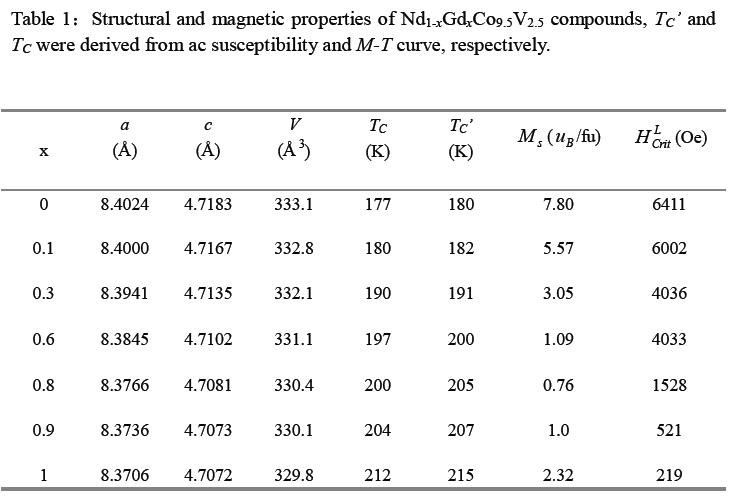

 where C1 and C3 are the coefficients in the expression for the free energy [14]. The Curie temperature can be obtained from the peak temperature where C1(TC') = 0 and listed in Table 1. The TC derived from M-T curves coincidence well with that from the χ ac peak. As listed in Table 1, the Curie temperature increases with increasing Gd content (shown in the inset of Fig. 3), reaching the value of 212 K for x = 1, which is in good accordance with the value reported in ref. [15].



 , where G(J) is the de Gennes factor
 . G(J) equals 1.84 and 15.75 for free Nd3+ ion and Gd3+ ion, respectively. The exchange coefficient nRCo decreases continuously across the lanthanide series due to the contraction of the 4f shell and the smaller overlap between the 4f and 5d shells. It can be seen from the inset of Fig. 4 that the Curie temperature TC increases almost linearly except for x=1 with the average square root of G(J). Thus, for the Nd1-xGdxCo9.5V2.5 compounds, the contribution of the de Gennes factor is dominant, leading to the monotonic increase of the Curie temperature with increasing Gd content.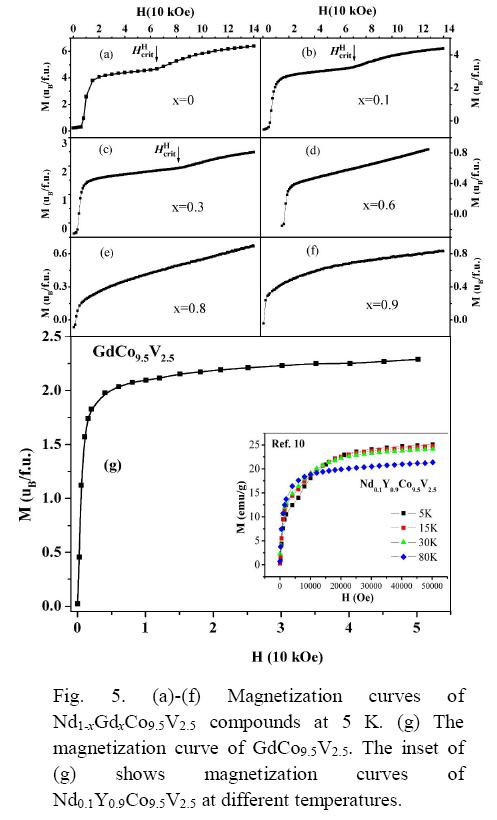
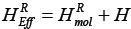 , the molecular field HmolR on each rare-earth atom is determined by the total number of nearest-neighbor magnetic Co atoms. In addition, the exchange-interaction field from the T sublattice acting on the R sublattice is described by